A workplace fire-safety purchase is incomplete when it consists of generic extinguishers without hazard mapping, evacuation equipment, service records or trained users. By the end, you will be able to build a product list around your fuels, layout, occupancy and response plan, then compare suppliers on installation, documentation and ongoing maintenance.
Key takeaways
- Map fuels, ignition sources, occupancy and escape routes before requesting quotes.
- Select extinguishers by fire class, rating and travel distance—not size alone.
- Require installation, training, inspection records and service terms from suppliers.
- Check seals, pressure indicators, labels, batch details and certificates on delivery.
Map the Fire Hazards Before You Request a Quotation
A workplace fire hazard assessment must precede the quotation. Map each fuel, ignition source and exposure, then overlay floor area, occupancy, storage layout, escape routes, charging points and hot work areas. Record local fire authority requirements and the standard used, because a numerical extinguisher rating does not prove that its agent suits every fire.
| Risk or classification | Conditions to identify | Buying consequence |
|---|---|---|
| Class A ordinary combustibles | Paper, wood, textiles, packaging | Select suitable water or foam units by rating and travel distance |
| Class B flammable liquids | Solvents, fuels, paints and oil stores | Specify foam or dry chemical powder for spill size and location |
| India: Class C gases | LPG, CNG, acetylene and cylinder banks | Place dry-powder protection near cylinders, manifolds and process points |
| International: Class C energized electrical | Live panels, machinery and chargers | Specify non-conductive agents; isolate power before firefighting |
| Lithium-ion batteries | Charging racks, damaged packs and battery storage | Add thermal-runaway controls and a response procedure |
| Combustible metals | Magnesium, sodium, titanium or metal dust | Buy Class D media; an ABC extinguisher is unsuitable |
| Class K cooking oils | Commercial fryers and grease extraction | Specify wet-chemical equipment, not water |
Include hazard mapping and placement calculations in the quotation. Base quantities on the actual hazard size and governing travel-distance rules, then confirm locations, signage and clear access rather than counting extinguishers by floor area alone.
Choose Extinguishers by Fuel, Rating and Travel Distance
Choose portable fire extinguishers by fuel, extinguisher rating and hazard size, not by buying generic ABC units. A water extinguisher suits ordinary combustibles; a foam extinguisher suits suitable Class A and B risks; a dry chemical powder extinguisher handles flammable liquids and electrical equipment; a carbon dioxide extinguisher suits electrical equipment and some flammable-liquid fires.
Neither rating replaces Class D media or Class K wet chemical.
| Type | Suitable hazard | Critical limit |
|---|---|---|
| Water extinguisher | Wood, paper, textiles | Do not use on energized equipment |
| Foam extinguisher | Class A and selected Class B | Check fuel compatibility |
| Dry chemical powder extinguisher | Flammable liquids and electrical equipment | Residue can damage machinery |
| Carbon dioxide extinguisher | Electrical equipment and some liquids | Short discharge duration |
| Class D media | Combustible metals | Match the specific metal |
| Class K wet chemical | Commercial cooking oils | Use at cooking appliances |
Place units on the route to an exit and near the hazard, keeping access visible and clear. Maintain these maximum travel distances: 75 ft Class A, 50 ft Class B, 75 ft Class D and 30 ft Class K; Class C follows the underlying Class A or B hazard.
Specify cabinets, brackets, mounting height and signage: the top is no higher than 5 ft for units up to 40 lb or 3.5 ft for heavier units, with the bottom at least 4 in. above the floor.
Train users in the PASS technique. A Fire Ball is a supplementary device, not a replacement for an extinguisher, alarm or evacuation; confirm its discharge duration, activation conditions and coverage before installation. Include monthly visual inspections, annual maintenance and the applicable hydrostatic-test interval in the purchasing plan.
Buy the Equipment That Makes Evacuation Work
Turn the emergency action plan into a usable workplace system by buying detection, warning, water-delivery and route-control equipment as a matched set. A fire alarm panel must receive signals from smoke detector and heat detector zones, while a manual call point lets anyone raise the alarm.
Specify an audible and visual alarm where machinery, noise or hearing loss could hide a siren.
| System | Product | Decision check |
|---|---|---|
| Detection | Fire alarm panel, smoke detector, heat detector, manual call point | Confirm coverage, zoning, power backup and accessible call points |
| Warning | Audible and visual alarm | Check sound and light reach occupied areas, toilets and noisy zones |
| Water delivery | Hose reel and fire hydrant | Verify flow, pressure, hose length, access and connection compatibility |
| Evacuation | Emergency lighting and exit signs | Test visibility during power loss and along every escape route |
Buy evacuation maps showing “You are here,” exits and fire equipment, plus assembly-point signs at the muster location. Use photoluminescent signs where smoke or power loss can reduce visibility. Keep unobstructed exit routes, and ensure fire doors close fully, retain their labels and open from inside without a key or tool.
A sign cannot correct a blocked corridor or locked exit.
Match First-Response PPE and Support Equipment to the Task
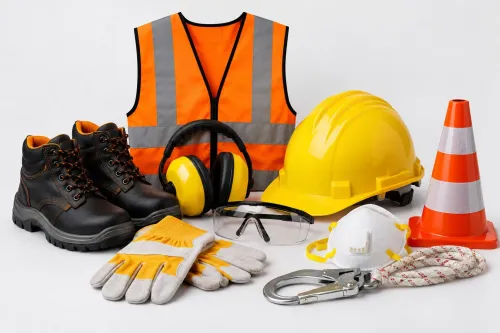
Buy first-aid kit contents for the injuries your risk assessment predicts: burn dressings, sterile gauze, eye irrigation supplies and disposable gloves. Do not accept “industrial-grade” as a specification; require sizes, quantities, expiry dates and a replenishment list.
Match each item to the exposure:
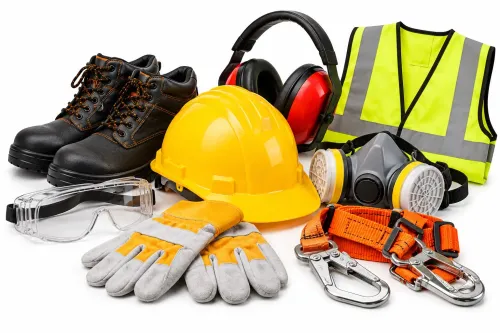
- Heat and sparks: safety glasses, a face shield and flame-resistant workwear.
- Molten splash: a face shield with the specified impact and heat protection, plus heat-resistant gloves and clothing.
- Chemical splash: sealed goggles, a face shield, compatible gloves and chemical-resistant clothing.
- Energized electrical work: arc-rated clothing with its arc-rating information; FR labelling alone does not prove arc-flash protection.
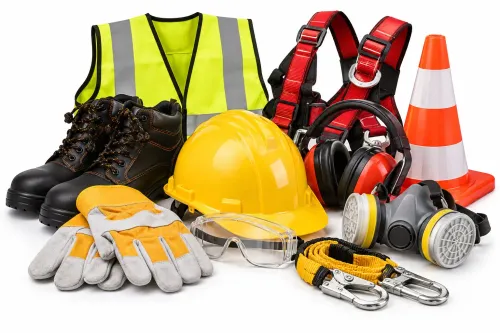
Respirators require a written respirator program, medical evaluation, contaminant-specific cartridges and fit testing before use and at least annually for tight-fitting facepieces. Specify a NIOSH-approved configuration, not interchangeable catalogue parts.
For confined spaces, order an atmospheric monitor with oxygen testing, combustible and toxic-gas sensors, calibration gas, regulator, bump-test equipment and calibration instructions. Test oxygen first.
Install emergency eyewash equipment meeting ANSI/ISEA Z358.1: activation within one second, tepid flushing for 15 minutes and an unobstructed route reachable within about 10 seconds. Select spill media by chemical spill compatibility; check each SDS before choosing an absorbent.
Check Compliance, Condition and Serviceability on Delivery
Reject any extinguisher that arrives without a legible BIS marking, the applicable BIS standard by extinguisher type, manufacturer details, and traceable identification. A rating label alone does not prove that its agent suits the hazard.
On delivery, verify:
- Identity: match the batch number, serial number, manufacturing date and test date to the delivery note and certificate.
- Condition: inspect the cylinder for corrosion, dents or leakage; check that the pressure gauge sits in the serviceable zone.
- Security: confirm the intact seal, readable operating instructions, sound hose and unobstructed nozzle.
- Suitability: match the agent and rating to the identified fire class, not merely to a generic ABC specification.
- Records: obtain service records and enter each unit in the inspection register with its location and identification numbers.
Agree the maintenance dates before installation. Schedule a monthly visual inspection and annual maintenance, then record findings and corrective work. Confirm hydrostatic testing due dates: use the five-year water/AFFF interval and the twelve-year carbon-dioxide and dry-chemical interval where those intervals apply to the cylinder and agent.
Missing records, an overdue test date or a damaged seal leaves readiness unproven.
Compare Suppliers on Installation, Training and Total Ownership
After product prices, supplier comparison depends on execution. Require each quotation to state whether it includes a hazard survey, placement calculation, installation, commissioning and records.
| Criterion | Supplier A | Supplier B |
|---|---|---|
| Installation | Names mounting, alarm-testing and handover tasks | Says “supply only” |
| Service | Prices refill, hydrostatic test, inspection visits and after-sales service | Gives no schedule or interval |
| Readiness | Provides training covering emergency call procedure, alarm raising, evacuation, assembly-point accounting, role assignment and when not to fight a fire | Offers a product demonstration only |
| Support | States replacement lead time and corrective action route | Provides a sales contact without response times |
Calculate total ownership effort over five years: service visits, consumables, staff time, downtime and documentation, not just purchase cost. Innovative Safety Solutions is worth comparing on this evidence, not catalogue breadth.
Related products
 | Fire Safety By Innovative Enterprises (Safetywala), Ambad, Nashik 📞 Contact: Mr. Mayur R. View product → |
 | Industrial Safety By Innovative Enterprises (Safetywala), Ambad, Nashik 📞 Contact: Mr. Mayur R. View product → |
Frequently asked questions
What should you map before requesting a fire safety quotation?
Record fuels, ignition sources, exposure areas, floor space, occupancy, storage layout, escape routes, charging points and hot work areas. Include local fire authority requirements and the standard used.
How do you choose the right workplace fire extinguisher?
Match the extinguisher agent to the fuel and fire class, then check its tested rating and travel distance to the hazard. A higher numerical rating does not prove that the agent suits every fire.
What equipment helps make workplace evacuation work?
Source clearly marked exit signs, emergency lighting, alarms, evacuation instructions, assembly-point identification and equipment that keeps escape routes usable for the site’s occupancy and layout.
What should you check when fire safety equipment is delivered?
Check seals, pressure indicators, labels, batch or serial details, expiry or service dates, certificates, physical condition and evidence that installation and servicing requirements are documented.
Related products
 | Industrial & Occupation Safety By Innovative Enterprises (Safetywala), Ambad, Nashik 📞 Contact: Mr. Mayur R. View product → |
 | Industrial Safety By Innovative Enterprises (Safetywala), Ambad, Nashik 📞 Contact: Mr. Mayur R. View product → |