
A carton that survives a warehouse stack can still fail in a humid container, and a pallet rated for floor storage can collapse under forklift movement. Define the load, route, product hazards and measurable package performance before you compare suppliers, then verify that the quoted material works in a production-representative pack-out.
Key takeaways
- Define product, pack configuration, handling method and distribution route before requesting quotes.
- Match material strength and protection to compression, impact, moisture and vibration risks.
- Request samples, standards, test records and traceability documents before approval.
- Run a controlled trial and check continuity plans before awarding the contract.
Turn the product and distribution route into a purchase specification
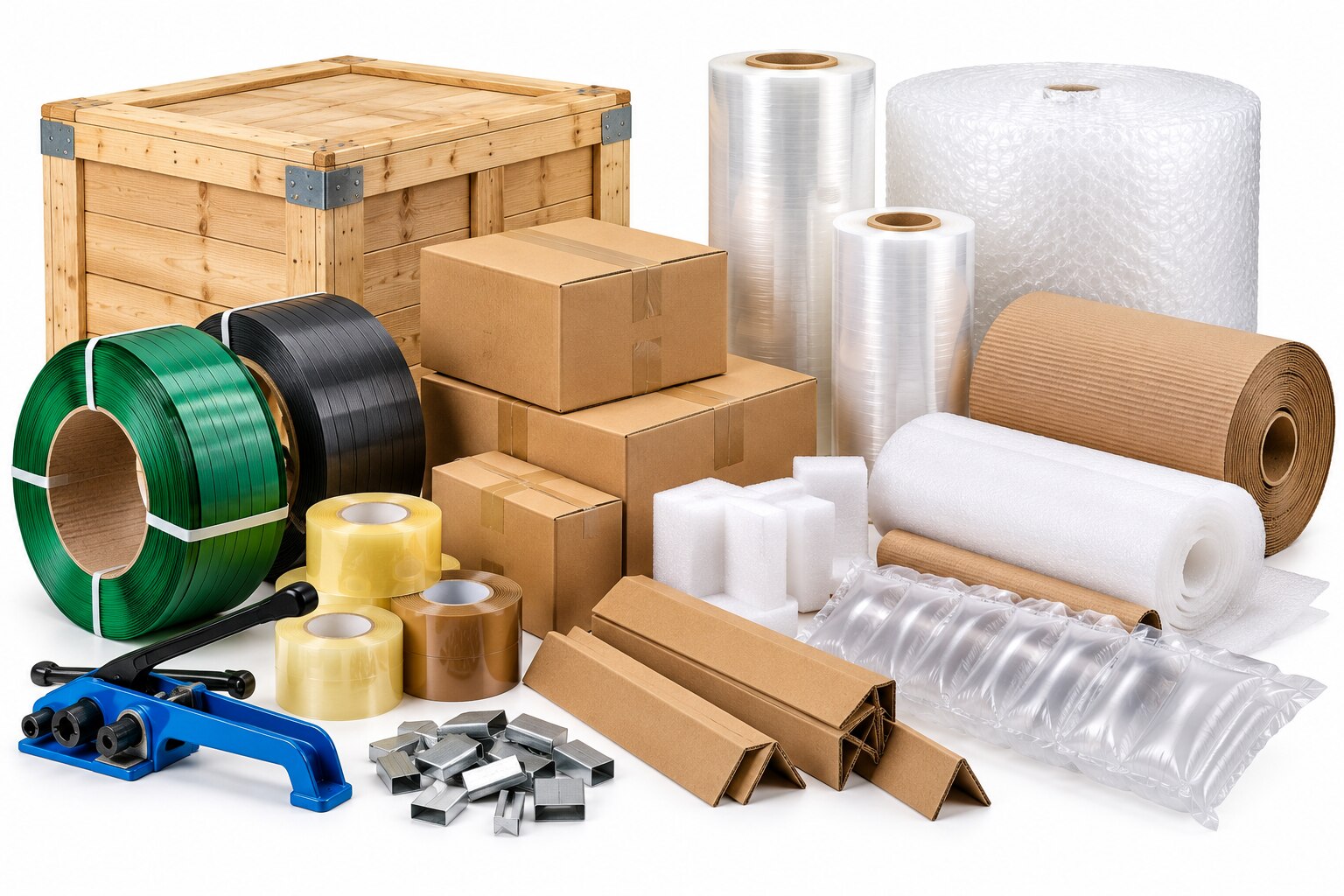
Give every supplier a measurable purchase specification before asking for a price. Define the product, pack configuration, handling method and distribution route, then compare suppliers of corrugated cartons, wooden crates, pallets, stretch film, strapping, edge protectors, drums, woven sacks, liners, rigid containers and protective foams against the same requirements.
- State the load: product dimensions and mass, centre of gravity, sharp edges, allowable compression, stacking height, pallet footprint, forklift or clamp handling, and the required number of units per pack.
- State material performance: carton board grade and ECT or burst requirement; crate and pallet load class; film thickness and stretch range; strap width and breaking strength; foam density; drum or rigid-container capacity; puncture, moisture and temperature limits; closure method; and permitted dimensional and defect tolerances.
- State the route: transport modes, expected drops and vibration, storage duration and climate, exposure to rain or condensation, export destinations, and whether ISPM 15 treatment and the correct IPPC mark apply to wood packaging.
- State compatibility controls for chemicals, coatings, adhesives, elastomers and corrosion-sensitive steel. Name the barrier film, desiccant or volatile corrosion inhibitor, storage period and contact restrictions instead of accepting “corrosion resistant.”
- Require a production-representative filled-system trial. Test the product, cushioning, pallet pattern, stretch film, strapping and edge protectors together for compression, drops, vibration and load stability.
For sustainability, specify the functional unit: protection of one shipped product through one defined distribution cycle. Compare damage, replacement shipments and disposal alongside packaging weight or recycled content.
Match the packaging material to the product and transport risk
Choose packaging by the product’s failure mode and route, not price or a “heavy-duty” label. Compression strength will not stop vibration damage, rain ingress, leakage or chemical attack.
| Product or risk | Packaging direction | Check before ordering |
|---|---|---|
| Fragile machinery packaging | Crate or reinforced carton, foam, blocking and moisture barrier | Test drops, vibration, compression and handling as a filled system |
| Powder and liquid packaging | Sealed liner or rigid container; use secondary containment for liquids | Check leak, puncture, dust-control and stacking performance |
| Wet or rain-exposed goods | Barrier film, sealed closures and desiccant where required | Confirm moisture exposure and storage duration |
| Corrosive chemical packaging | Compatible drum, jerrican, liner or rigid container | Check chemical, concentration, temperature, closure and storage compatibility |
| Hazardous materials packaging | UN design-type package matched to contents, fill weight and transport mode | Verify certificate, packing instruction, permitted contents and closure method |
| Export cargo packaging | ISPM 15-marked wood or a non-wood alternative | Check destination rules and container humidity exposure |
| Food-contact packaging | Approved, clean liner or container with non-migrating surfaces | Request the declaration or test report for the food and contact conditions |
| Oversized equipment packaging | Engineered skid or crate with bracing and lifting points | Confirm centre of gravity, fork access, footprint and route clearances |
For corrosion-sensitive steel, select barrier film, desiccant, volatile corrosion inhibitor or coating against the storage climate and contact materials. “Corrosion resistant” does not prove compatibility with paint, adhesive or elastomers.
Run a production-representative pack-out on the intended equipment. Test the complete palletised load: board caliper, film friction, strap tension and pallet footprint can cause jams or unstable loads.
Request standards, samples and proof that the material performs
Do not accept “heavy-duty,” “export quality” or a supplier’s brochure as performance evidence. Ask for a production sample, the governing standard, a certificate of analysis, and a signed test report tied to the quoted grade. Require batch traceability from raw material or board lot to finished packs, so a failure can be contained and investigated.
Request these records before approval:
- Corrugated boxes tested to IS 6481, with board grade, dimensions, tolerances and closure method stated.
- Wooden export packaging bearing a legible ISPM 15 mark; record the treatment provider and mark details.
- Dangerous-goods packaging with UN performance certification covering the exact packaging design, packing group and tested contents.
- Current calibration records for compression, burst and weighing equipment, plus the supplier’s certificate of conformance.
- Samples from normal production, not specially selected prototypes, for your own pack-out and route testing.
ECT and burst strength answer different questions. ASTM D4169 and ISTA procedures also use different test sequences and assurance levels, so name the selected procedure and distribution cycle in the purchase specification.
| Evidence | What it demonstrates | What to check |
|---|---|---|
| ECT | Carton edge-compression capacity and stacking relevance | Value, board grade and test method |
| Burst strength | Resistance to puncture and rupture | Specified units, sample lot and failure limit |
| ASTM D4169 | Distribution hazards under a defined assurance level | Route, handling and climate profile |
| ISTA procedures | Package suitability under the chosen ISTA test plan | Exact procedure, pack-out and pass criteria |
Compare supplier capability, quotation terms and continuity risk
A quote is incomplete until you calculate its delivered and failure-adjusted cost. Compare the same release quantity, packaging specification and delivery point; a lower unit price can lose its advantage through freight, storage, damage and repacking labour.
| Supplier evidence | What to compare | Cost or risk revealed |
|---|---|---|
| Capability | Custom packaging dimensions, tolerances, capacity evidence and test samples | Rework, rejected packs and production delays |
| Quotation | Minimum order quantity, release quantities, price-break volumes, tooling and die charges, freight and payment terms | Cash tied in stock and true delivered cost |
| Continuity | Manufacturing-site location, raw-material dependencies, emergency replenishment lead time, recovery time, alternate plant or tooling | Exposure to shortages and missed dispatches |
Use this industrial packaging supplier checklist before ranking quotations:
- Ask who owns the tooling, who pays for replacement dies and who carries obsolete stock after a design change.
- Confirm storage requirements, including covered space, humidity control, pallet stacking limits and protection from contamination.
- Require a written emergency replenishment commitment, not an informal promise.
- Request the supplier’s backup manufacturing arrangement and the conditions permitting material or component substitutions.
- Price the consequence of one failed shipment: damaged goods, repacking, customer claims and line stoppage.
A second source is usable only after its material and pack-out pass the same performance checks. INNOVATIVE SAFETY SOLUTIONS can be included in that comparison when you need a local source for safety-related packaging and handling requirements, but proximity does not replace capacity evidence or a continuity plan.
Approve the supplier through a controlled trial, not a promise
A successful sample does not qualify a supplier for routine orders. Approve only after the material survives your equipment, distribution conditions and document review.
1. Run a production-representative pack-out on the intended filling, closing and palletising equipment. Record jams, line speed, labour changes, closure quality, compression and load stability.
2. Complete packaging validation against the purchase specification, including dimensions, tolerances, defect rate and pallet load class. For humid storage, outdoor staging, refrigeration or sea freight, include moisture conditioning at representative temperature and humidity.
3. Require lot traceability from supplied material to production records, plus a certificate of conformance stating the actual grade, test results, lot number and specification limits. Review calibration records, nonconformance reports and corrective-action history.
4. Obtain written change notification requirements covering materials, tooling, manufacturing site, adhesives, coatings and subcontractors. Confirm capacity, raw-material dependencies, recovery time and an approved alternate plant or tool before a disruption occurs.
5. Run a sustainable packaging comparison using one functional unit, such as protecting one product through its defined distribution cycle. Compare damage, moisture failures, replacement shipments, disposal and packaging use—not only weight or recycled content.
Release regular orders only when the trial results, records and signed acceptance criteria are complete. Treat a second source as unapproved until its material and pack-out pass the same validation.
Frequently asked questions
What information should you give packaging suppliers before requesting prices?
Give each supplier the product dimensions, weight, fragility, pack configuration, stacking height, handling equipment, storage conditions and distribution route. Include exposure to moisture, vibration, impact and temperature, plus required quantities and delivery locations.
How do you match industrial packaging material to transport risk?
Assess the product and route for compression, puncture, abrasion, shock, vibration, moisture and load movement. Select carton strength, crate construction, pallet design, film thickness, strapping and protective inserts against those specific risks rather than choosing by material name alone.
What should you request from an industrial packaging material supplier?
Request material specifications, applicable standards, sample packs, test reports, batch or lot traceability, storage instructions and evidence from a comparable application. Inspect samples for dimensions, closures, joints, seams and damage after testing.
How should you approve a packaging supplier?
Run a controlled trial using your actual product, pack method, handling equipment and distribution route. Record damage, pack time, material consumption, rejected units and delivery performance, then approve the supplier against written pass-fail criteria.