A sign improves safety only when people can identify the hazard, read the message in time, and understand what action to take. By the end, you will have a practical method for selecting the message, sizing and placing the sign, combining it with physical controls, and specifying a supplier’s work so the system remains effective outdoors.
Key takeaways
- Start with the hazard, audience and required action.
- Place messages before drivers reach the decision point.
- Specify visibility for daylight, darkness and bad weather.
- Inspect signs and remove them when hazards change.
Start With the Hazard, Audience and Required Control
Decide what must change before deciding how the sign should look. Identify the hazard, the people exposed, the moment they encounter it, and the control you need: slow down, keep out, wear eye protection, report a spill, or follow an escape route.
A hazard communication system fails when a sign names danger but does not tell its audience what action prevents harm.
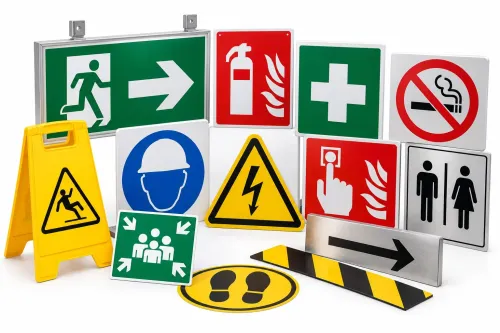
| Sign type | What it must communicate | Example |
|---|---|---|
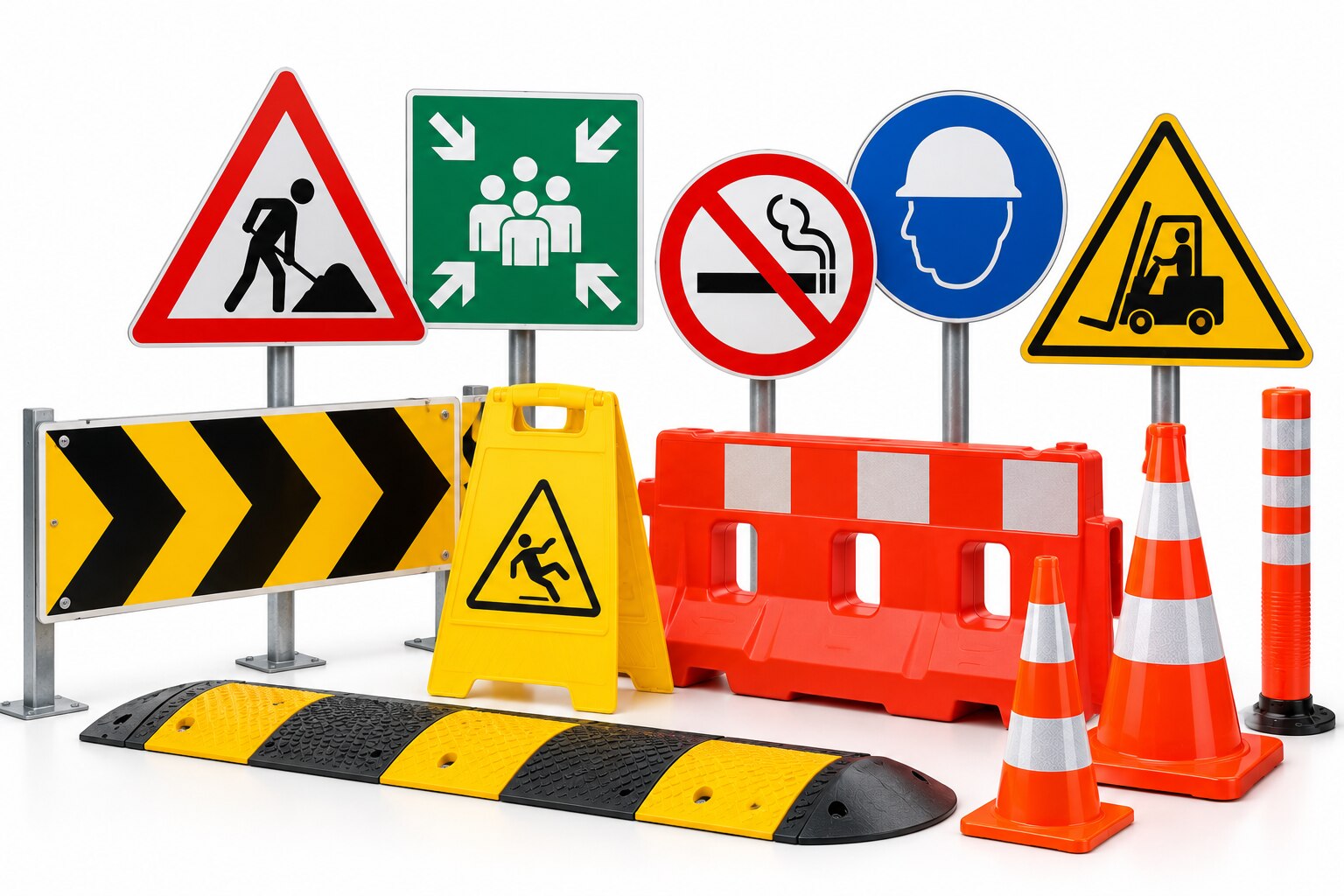
| Warning signs | A hazard exists and demands caution | “Forklifts crossing” |
| Prohibition signs | An action or entry is forbidden | “No smoking” or “Do not enter” |
| Mandatory-action signs | A specific protective action is required | “Wear hard hat and safety footwear” |
| Emergency-information signs | Where to find help, escape, first aid or firefighting equipment | “Emergency exit” or “Fire hose reel” |
Match the message to the governing setting before selecting symbols. ISO 3864-1 separates these categories by shape and colour, while ISO 7010 provides registered safety pictograms; a branded shape can change the understood meaning. Road signs in the United States must follow the Manual on Uniform Traffic Control Devices.
Do not use an outdoor sign to replace GHS container labels, and use temporary tags only while the identified hazard exists. For mixed-language or mixed-literacy audiences, pair a tested pictogram with concise text naming the hazard and required action.
Write a Message Drivers Can Read Before the Decision Point
Place the essential action where the reader can understand it before the decision point, not beside the hazard. A vehicle operator approaching at 40 km/h has less time than a pedestrian walking at 5 km/h, so set letter height, sign viewing distance and message length for the fastest approach.
1. Measure the longest practical viewing distance and calculate available reading time from the approach speed. Check the sign from the driver’s eye position, including the actual viewing angle, mounting height, glare and obstructions.
2. Put the hazard and action first: “TRUCKS ENTERING—STOP” or “DO NOT ENTER—LIVE TRAFFIC.” Remove greetings, explanations and duplicate wording. Use a large, high-contrast legend; increase letter height when speed, distance or viewing angle increases.
3. Add safety pictograms that reinforce the exact hazard, such as a pedestrian-crossing symbol or falling-object warning. Use symbols from ISO 7010 where suitable, but retain the required signal word, color and shape; an icon alone can confuse workers facing several similar hazards.
4. For multilingual safety signs, keep one short command and add tested translations in separate lines or panels. Do not compress three long sentences into a small face. Give vehicle operators priority with fewer words, while a worker-facing sign can carry a short instruction and contact or permit detail.
Apply MUTCD design and placement provisions to road approaches, then assess workplace signs separately. Have people from each user group read the sign at the real approach speed and distance; if they cannot state the hazard and required action, rewrite it.
Specify Visibility and Placement for Day, Night and Bad Weather
Place the outdoor sign before the hazard, at the point where the reader still has time to slow, stop or change direction. Calculate the advance warning distance from approach speed, viewing distance and the action required; do not place a vehicle warning beside the decision point.
Keep the face unobstructed by branches, parked vehicles, dust or temporary materials, and set the mounting height within the reader’s clear line of sight. On U.S. public roads, follow MUTCD meaning, color, shape and placement rules rather than a custom layout.
| Audience or condition | Placement | Visibility specification |
|---|---|---|
| Pedestrians | Along the walking route, before the conflict point | Size letter height for the actual viewing distance; use strong light-dark contrast and an ISO 7010 pictogram when appropriate |
| Daylight vehicle approach | Before the required maneuver, outside the recovery zone | Use a rigid, weather-resistant substrate, high-contrast legend and fluorescent orange only when daytime conspicuity is needed |
| Night, rain or dust | At the same decision point, facing approaching traffic without glare | Specify retroreflective sheeting ASTM D4956 type, required observation and entrance angles, and adequate nighttime performance |
Treat daytime fluorescence and nighttime retroreflection as separate specifications. “Reflective vinyl” is incomplete: record the sheeting type, substrate, exposure warranty and replacement or inspection method. Clean the face when mud, salt or dust reduces contrast, because an intact sign can still fail at night.
Use lighting only when it does not wash out the legend or blind approaching users.
Choose the Right Visibility Method With a Supplier
Choose the visibility method according to who must notice the sign, how much decision time they have, and what light exists at the hazard.
| Option | Choose it when | Main limitation |
|---|---|---|
| Passive reflective signs | Vehicle headlights must reveal a fixed warning, regulatory sign or direction at night | They need a clear beam and specified retroreflective performance, not merely “reflective vinyl” |
| Autoglow safety signs | People need guidance during a power failure or in dark areas after the sign has been charged by ambient light | They do not replace daytime contrast or guarantee visibility through smoke, dirt or blocked sightlines |
| Solar blinkers | A high-risk point needs attention from approaching drivers or pedestrians where a flashing beacon is justified | Batteries, solar-panel exposure and flash visibility require inspection |
| Solar height indicator lights | An overhead obstruction, gateway or clearance limit must be identified to vehicle operators at night | They mark the height hazard; they do not replace a readable clearance sign |
Ask an outdoor safety signages supplier to document the governing standard, hazard purpose, audience, legend, pictogram source, face material and retroreflective class. For road applications, name the MUTCD provision and ASTM D4956 sheeting type or equivalent observation and entrance-angle performance; ISO 7010 or ISO 3864-1 does not establish local compliance by itself.
The submittal must also state:
- Substrate, dimensions, letter height, mounting height and fixing method
- Viewing distance, approach speed, viewing angle and glare controls
- Weather exposure, solar-panel and battery assumptions, and cleaning access
- Nighttime inspection method, retroreflectivity criterion and replacement trigger
INNOVATIVE SAFETY SOLUTIONS can help compare these fields across a sign schedule instead of comparing colour and nominal size alone.
Related products
 | Road Safety By Innovative Enterprises (Safetywala), Ambad, Nashik 📞 Contact: Mr. Mayur R. View product → |
 | Safety Signage & Indicators By Innovative Enterprises (Safetywala), Ambad, Nashik 📞 Contact: Mr. Mayur R. View product → |
Test, Maintain and Remove the Sign When the Hazard Changes
After installation, test the sign where people will use it: at the decision point, in daylight, at night, and during rain or dust. Ask workers, pedestrians and drivers to explain the required action; a sign that is visible but misunderstood has failed.
Use this sign inspection checklist after installation and at a defined interval:
- Confirm the sign faces approaching traffic, remains unobstructed and has not twisted, faded or lost contrast.
- Check mounting, fasteners and edges for damage, corrosion or theft.
- Clean dirt, mud, salt and biological growth without scratching the face.
- Record nighttime performance under the specified sheeting class and complete retroreflectivity maintenance before the sign becomes unreadable.
- Verify that the signal word matches the risk: reserve “DANGER” for an immediate serious hazard, and do not let tags replace permanent signs or engineering controls.
Review the hazard after every layout, traffic-route, process or weather change. Apply the hierarchy of controls first; a sign must not compensate for a missing barrier, guard or safer method. Remove or cover temporary construction signs promptly when the hazard ends, and remove tags when the identified condition no longer exists.
Assign one person to record inspection dates, defects, corrective action and removal approval. A quarterly review cannot correct a sign left misleading after yesterday’s excavation moved.
Frequently asked questions
What should you define before designing an outdoor safety sign?
Identify the hazard, exposed people, encounter point and control required, such as slowing down, keeping out or wearing eye protection.
How should you write a safety message for drivers?
Use a short, direct instruction that drivers can read before the point where they must decide or act.
What visibility factors matter for outdoor safety signs?
Plan for daylight, darkness, rain and other weather conditions, then specify suitable placement and visibility methods.
When should you remove or replace an outdoor safety sign?
Inspect it regularly and remove it when the hazard changes; replace signs that no longer communicate the required control clearly.
Related products
 | Industrial Safety By Innovative Enterprises (Safetywala), Ambad, Nashik 📞 Contact: Mr. Mayur R. View product → |
 | Road Safety By Innovative Enterprises (Safetywala), Ambad, Nashik 📞 Contact: Mr. Mayur R. View product → |
 | Road Safety Equipments By Innovative Enterprises (Safetywala), Ambad, Nashik 📞 Contact: Mr. Mayur R. View product → |