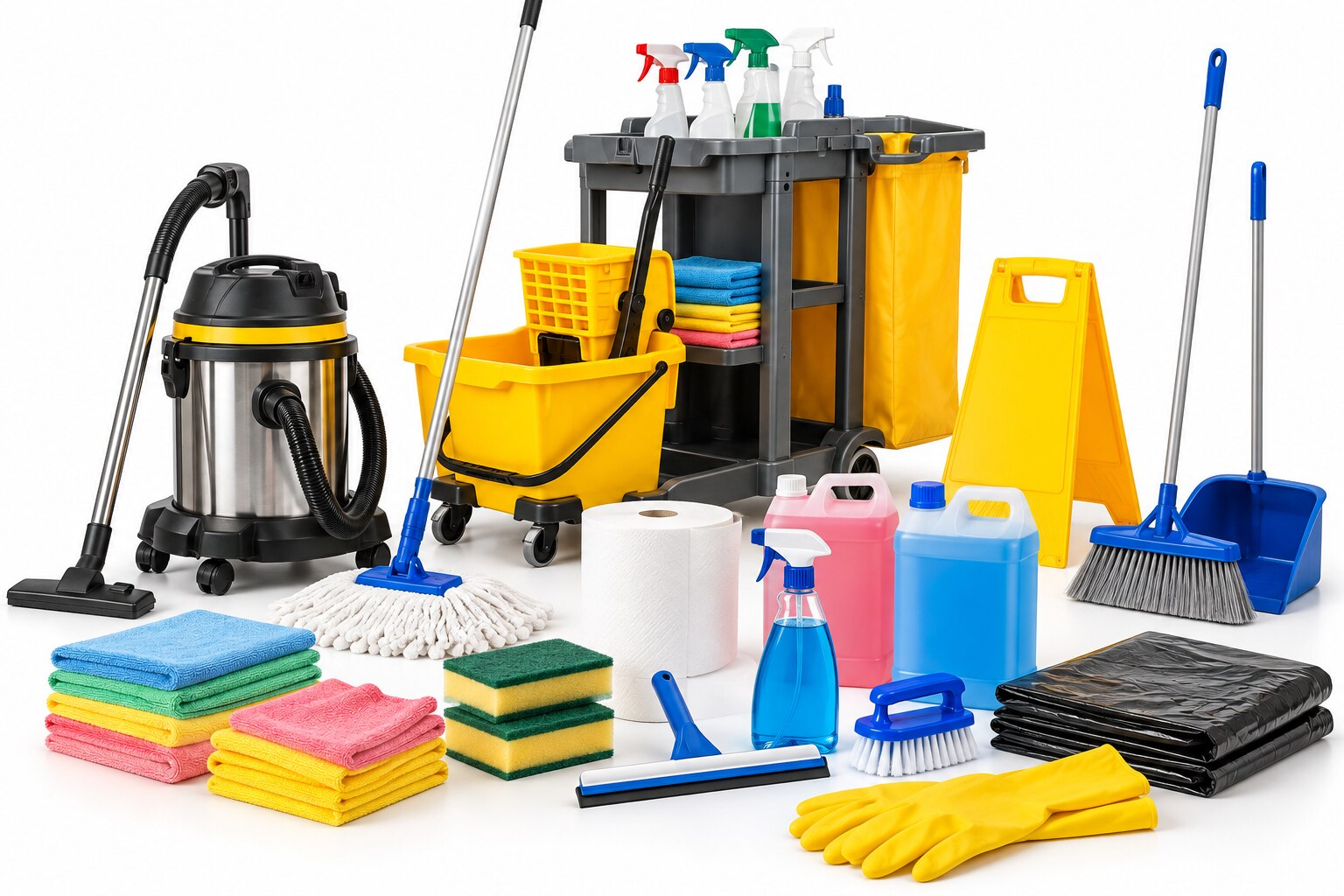
Commercial cleanliness depends on more than buying bins and disinfectant. You need a repeatable cleaning schedule, correctly placed waste containers, compatible chemicals and equipment, trained staff, and a supplier that can maintain the system when demand changes or stock runs short.
Key takeaways
- Set cleaning frequency by risk, traffic and occupancy.
- Match bin capacity and design to each location’s waste.
- Keep waste streams separate and disinfect bins on a defined schedule.
- Test supplier stock, delivery and product compatibility before committing.
Build a Cleaning Programme Around Risk, Traffic and Occupancy
Set the commercial housekeeping programme by exposure risk, foot traffic and occupancy, not by a uniform calendar. Map entrances, toilets, food areas, loading bays, production zones, offices and storage aisles; increase frequency where people, soil, spills or infectious material accumulate. A lightly occupied archive needs less attention than a busy retail restroom.
- Daily cleaning checklist: inspect at opening and closing; remove waste, clean toilets and touchpoints, clear spills, and clean floors in entrances, aisles, warehouse routes and production areas. Clean soiled surfaces before disinfecting them. Treat blood or other potentially infectious material as regulated waste in closable, labeled or color-coded containers.
- Weekly cleaning tasks: wash less-accessible floor edges, clean under movable equipment, wipe doors and ledges, remove cobwebs, wash bins and inspect dispensers, mops, brushes and chemical labels. Record missed areas and recurring spills.
- Periodic deep cleaning: schedule carpet extraction, machine floor scrubbing, high-level dust removal, degreasing, ventilation-grille cleaning and dock or loading-bay washing according to soil, occupancy and process risk.
Give every task an owner, method, frequency and sign-off point. Store current safety data sheets with product identities, train staff on labels and dilution, and use labeled secondary containers for concentrates. In silica-generating work, replace dry sweeping or compressed air with the specified wet method or HEPA-filtered vacuuming.
Calculate Bin Capacity and Choose the Right Container for Each Location
Start with the waste stream and collection interval, not the floor area. For each location, estimate daily waste volume, multiply it by the days between collections, then add 25% spare capacity. The bin quantity calculation is: required containers = daily volume × collection days × 1.25 ÷ usable bin capacity.
Round up, provide one container for each separate stream, and never plan to fill liners to the rim.
| Bin design | Best location | Practical reason |
|---|---|---|
| Pedal bin | Toilets, clinics, food service | Hands-free opening reduces contact; choose a washable, closable model |
| Swing bin | Offices, corridors, reception areas | Fast disposal for dry waste where hands-free operation is not essential |
| Lidded wheeled bin | Warehouses, loading bays, outdoor points | Larger loads, easier movement and better protection from weather |
| Closable, labelled container | Blood-contaminated or regulated waste points | Contains contents and supports required colour coding or labels |
Base waste bin placement on where waste is created: beside printers, pantry exits, toilets, production stations, loading doors and building entrances. Put recycling containers beside the general-waste bin so users do not have to cross the room, and keep bins out of escape routes, door swings and spill-prone work zones.
Compare dust bin capacity with liner size, washability, corrosion resistance and lifting weight. A 60-litre bin that staff cannot move safely is a poor choice. Use a pedal bin versus swing bin decision based on hand contact, hygiene risk and traffic, then inspect fill levels for one week and adjust locations or quantities.
Separate Waste Streams and Control Bin Hygiene
Assign one clearly marked container to each waste stream, then keep the same colour, label and collection route throughout the facility. Inconsistent waste segregation causes recyclables to be rejected, food residue to attract pests and hazardous residues to enter ordinary waste.
- General waste: Use a lidded bin with a leak-resistant liner for non-recyclable, non-hazardous rubbish.
- Recyclable waste: Provide a recyclable waste bin for the accepted materials only, such as paper, cardboard, metal or plastic. Display the permitted items on the lid.
- Food waste: Use a washable, closable food waste container with a tight-fitting lid and remove its liner at least daily.
- Sanitary waste: Fit a pedal-operated sanitary waste bin in toilet cubicles and display sanitary waste bin labels that state what belongs inside.
- Hazardous waste: Use a compatible, sealed container marked with the waste identity and hazard information. Keep chemicals, contaminated absorbents and sharp items in separate containers when their risks differ.
Choose smooth, non-absorbent containers without cracked lids, rust or exposed seams. Secure the liner below the rim, never fill it beyond the marked capacity, and inspect floors around every bin for leaks.
Clean food and sanitary containers on a fixed schedule with detergent before disinfection; soil reduces disinfectant performance. Keep absorbent pads, compatible gloves and a spill container at waste points, because a wet-floor sign does not remove a leak hazard. Record fill level, liner change, washing and defects on a simple inspection sheet.
Buy Chemicals, Equipment and PPE as One Compatible System
Choose every item as part of one compatible system, not by lowest unit price. Match housekeeping chemicals to the floor finish, metals, plastics, machine seals and intended soil. Keep labels and SDS cleaning chemicals records current, including dilution, PPE, storage and waste instructions.
Require technical approval before replacing a disinfectant, floor finish, pad or glove material. A similar pack size can hide a different wet contact time, surface reaction, machine setting or disposal requirement.
Use this purchasing check:
- Select proportioning equipment, labelled secondary containers and a written chemical dilution control procedure for concentrates.
- Specify colour-coded mops, buckets, brushes and wipers by area; provide enough stock for soiled items to leave the floor for laundering or reprocessing.
- Match dispenser materials and liners to the chemical, waste type, temperature and load; confirm that liners fit without tearing or slipping.
- Choose nitrile, neoprene or other PPE from the chemical manufacturer’s compatibility guidance, then match gloves, eye protection, aprons and footwear to the task.
- Replace dry brooms and compressed air with wet methods or HEPA-filtered vacuums where respirable silica dust is present.
Never allow bleach or chlorine products near ammonia, acids or unapproved cleaners. Separate storage, clear labels and staff instructions prevent toxic gas formation. Require disinfectant users to keep the surface visibly wet for the label’s full contact time; wiping it dry early defeats the treatment.
Test a Supplier’s Reliability Before You Make It Your Primary Source
Ask for evidence before moving routine purchases to one housekeeping material supplier. A low invoice price cannot compensate for an empty storeroom, an unapproved chemical substitute or a complaint that remains unanswered.
1. Check supplier stock availability against your last three months of consumption. Ask which items are held in stock near Nashik, Dhule and Nandurbar, the normal delivery lead time to each site, the minimum order quantity, and the reorder trigger. Confirm the repeat-order process, including who receives your order and how shortages are reported.
2. Get a written substitution rule. A different disinfectant, floor finish, pad, filter or glove is not equivalent because the pack looks similar. Require technical approval before any change, with the revised contact time, compatibility information, PPE guidance and current SDS.
3. Inspect documentation at delivery. The container label must identify the product, hazard information and manufacturer; the SDS must match that product and remain accessible during every shift. For regulated waste, reject ordinary bags in place of closable, leak-containing, labelled or colour-coded containers.
4. Test delivery control with a small order. Record quantities, batch or lot details, expiry dates where applicable, damaged packaging and temperature-sensitive items. Chlorine products need clear segregation and instructions because mixing them with ammonia, acids or other cleaners can generate hazardous gases.
5. Send a deliberate complaint before signing a long-term agreement. Ask for a named contact, acknowledgement time, replacement or corrective-action procedure and escalation route. INNOVATIVE SAFETY SOLUTIONS can be compared on these records, not on catalogue breadth alone.
Related products
 | House Keeping By Innovative Enterprises (Safetywala), Ambad, Nashik 📞 Contact: Mr. Mayur R. View product → |
 | Industrial Safety Products By Innovative Enterprises (Safetywala), Ambad, Nashik 📞 Contact: Mr. Mayur R. View product → |
Frequently asked questions
How should you build a commercial cleaning programme?
Map entrances, toilets, food areas, loading bays, production zones, offices and storage aisles. Set cleaning frequency according to exposure risk, foot traffic, occupancy, soil, spills and infectious material.
How do you choose the right bin for each facility area?
Calculate expected waste volume and collection frequency, then match the container’s capacity, opening, lid, mobility and material to the location and waste type.
How can you improve bin hygiene and waste separation?
Assign separate containers to defined waste streams, label them clearly, use suitable liners and clean or disinfect bins when soiled or during scheduled housekeeping rounds.
How do you evaluate a housekeeping material supplier?
Check product compatibility, stock availability, delivery performance, documentation, replacement support and the supplier’s response during a controlled trial before making it your primary source.