A supplier is suitable only when its equipment matches your vessel, crew, passengers, route, water conditions and rescue plan, and when every safety-critical item arrives with verifiable approval and traceability. Use the checks below to compare suppliers on operational fit, documentation, inspection support and lifecycle cost rather than on catalogue breadth or the phrase “marine grade.”
Key takeaways
- Define the vessel, route and overboard rescue scenario before comparing suppliers.
- Match approval documents to the exact delivered equipment configuration.
- Compare flotation gear by performance, fit, inspection needs and service life.
- Buy lifebuoys as part of a complete recovery arrangement, not as isolated products.
Start with the operation, vessel and rescue scenario
A crew member falls overboard 200 metres from a quay at night; a passenger vessel may face dozens of people in cold, moving water far from shore. Define that rescue before choosing equipment.
Require a marine safety material supplier to support ports, shipyards, fisheries, offshore work, flood response, passenger vessels and inland-water transport safety equipment, not just sell products labelled “marine grade.”
| Operation or vessel | Conditions to specify | Equipment brief |
|---|---|---|
| Port or shipyard workboat | Distance from shore, quay access, machinery, crew size, rescue time | Work vests, lifebuoys with lines, throw bags, helmets and retrieval equipment |
| Inland passenger vessel | Passenger capacity, children, current, water temperature, evacuation route | Sized flotation for every person, accessible lifebuoys, lights and passenger instructions |
| Offshore vessel or installation | Wave height, wind, helicopter or boat recovery, longest response time | Immersion suits, thermal protection, approved survival craft equipment and communications |
| Flood-response craft | Debris, contaminated water, night work, rapid deployment | Buoyant PPE, water-resistant lighting, throw lines and equipment that remains usable when wet |
Put the conditions into a written specification: vessel type, flag, class, route, operating area, crew and passenger numbers, water temperature, expected immersion duration, rescue method and storage locations.
Make the supplier map every item to its carriage requirement and provide the exact approved model, size range, capacity, environmental limits, manufacturing date, batch or serial number, and inspection record. “SOLAS-compliant” alone is not a specification.
Demand approval documents that match the delivered configuration
A catalogue statement such as “SOLAS-compliant” does not prove acceptance. For each delivered item, require the applicable SOLAS Chapter III and LSA Code requirement, approving flag administration or recognized organization, and a type-approval certificate identifying the exact model, size, capacity, materials and component combination.
If the certificate covers only a product family, reject it until the supplier links it to the delivered configuration.
Request evidence tied to the item’s serial or batch number:
- Declaration or certificate of conformity
- Type-approval certificate and supporting test report
- Production or inspection record, where applicable
- Manufacturing date and expiry or replacement date
- Approved installation, operating and maintenance manual
- Maintenance record and stated operating limitations
- Written compliance matrix mapping the item to your flag, route, vessel type and facility
Approval route | Evidence to verify
US-flagged vessel | US Coast Guard approval number; exact manufacturer and model; limitations; current status in the USCG equipment database
EU-flagged ship | Applicable Marine Equipment Directive item, MED Wheelmark documentation and conformity-assessment record; a CE mark alone is insufficient
Fire equipment | Named marine approval route, agent type, rating, mounting arrangement and environmental limits; EN 3 alone does not establish marine acceptance
Other flag or class regime | Certificate issued or accepted by the flag administration or recognized organization, with carriage and installation limits shown for the vessel or facility
Compare flotation equipment by performance, fit and service life
A 150 N lifejacket is not automatically safer than a 50 N option. Select the ISO 12402 buoyancy class against water conditions, rescue time, clothing and work activity; extra bulk can obstruct climbing, harness use or deck work.
| Equipment | What to compare | Verification before issue |
|---|---|---|
| 50 N or 100 N buoyancy aid | Mobility, wearer skill and calm-water use | Correct size, adjustment and intact flotation |
| 150 N or 275 N lifejacket | Self-righting performance, clothing and unconscious-person protection | Approval certificate, whistle, retroreflective panels and tested fit |
| Inflatable lifejacket or inflatable personal flotation device | Inflation method, cylinder, automatic or manual activation and servicing route | Trigger, bladder, oral tube, CO2 cylinder, seal and service date |
| Inherently buoyant work vest | Continuous wear, snag risk and compatibility with helmets or harnesses | Foam condition, corrosion-free hardware and secure closures |
| Immersion suit | Water temperature, rescue time, insulation and donning time | ISO 15027 part, abandonment or constant-wear purpose, closures and size |
Have each wearer put the equipment on over the clothing used on duty. Check that it stays secure during bending, climbing and water entry without restricting breathing or harness attachment. Keep child and adult sizes separate; a loose lifejacket can ride over the face.
Ask the supplier for the exact model, approval number, batch or serial traceability, manufacturing date and replacement schedule. For SOLAS-covered inflatable equipment, confirm an approved service station and servicing at intervals not exceeding 12 months; replace damaged flotation, expired cartridges and unserviceable suits rather than extending their life by appearance alone.
Specify lifebuoys as part of a complete recovery arrangement
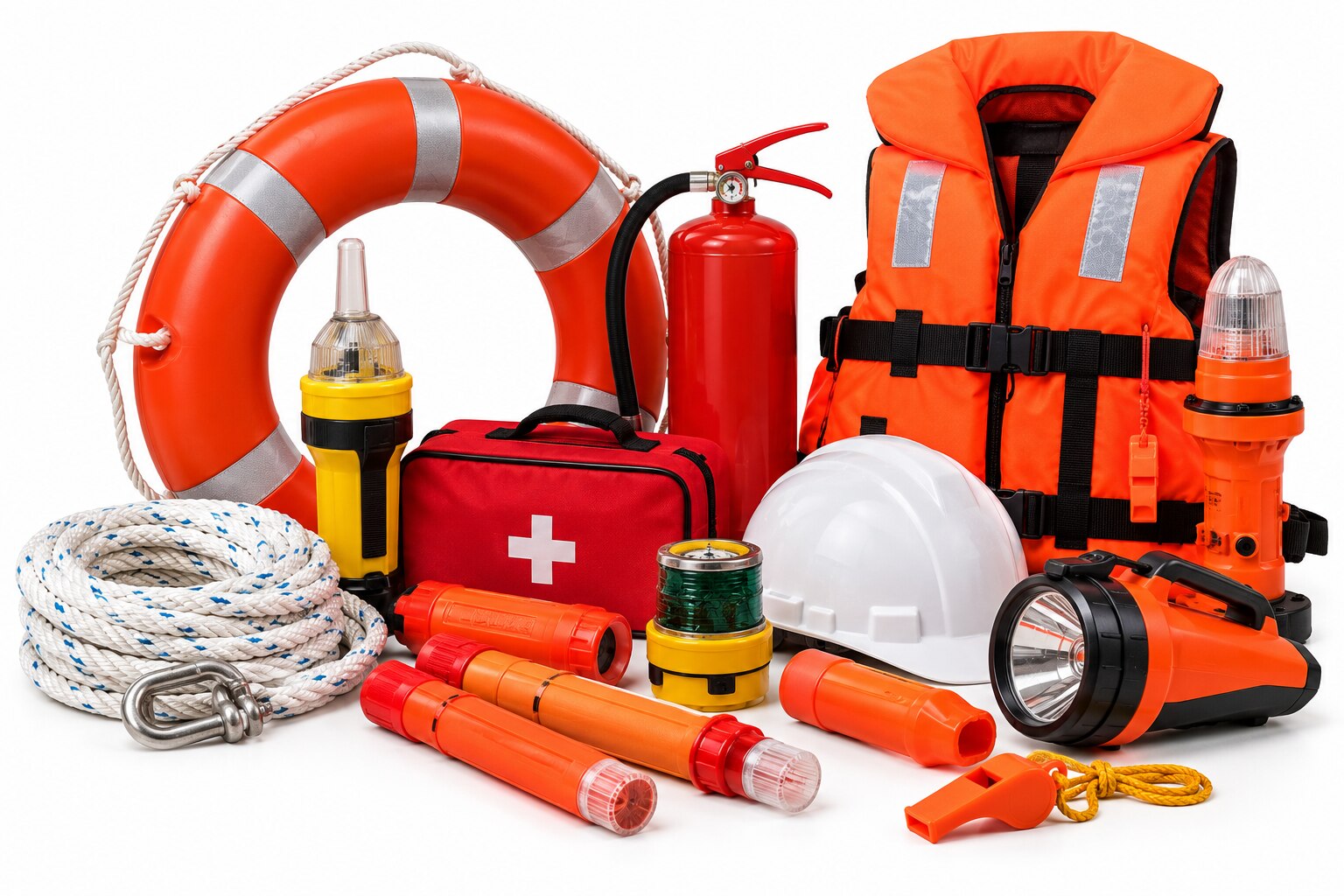
A lifebuoy only starts man-overboard recovery; it does not retrieve an unconscious person. Base lifebuoy selection on freeboard, water temperature, crew response time, vessel layout and approval requirements, then specify buoyancy, colour, diameter, grab line, retroreflective tape and accessories.
Position lifebuoys where a person can reach them without entering a locked space: on both sides of exposed decks, near the stern, at embarkation points and beside work areas.
Follow the vessel’s approved safety plan and the LSA Code; a buoy fitted with a buoyant line needs at least 30 metres of line, while a buoy with a self-igniting light and smoke signal requires the higher specified mass.
Use this inspection checklist:
- Check the shell for cracks, distortion, oil damage and waterlogging; replace a damaged buoy.
- Confirm the grab line is secure around the buoy, the buoyant line has no cuts or knots, and retroreflective tape remains firmly attached and visible.
- Test light and smoke-signal expiry dates, brackets, quick-release fittings and identification markings.
- Add a heaving line when wind, current, distance or freeboard makes a hand-thrown buoy difficult to deliver accurately.
- Provide a rescue boat or davit-launched device when the casualty needs controlled lifting, the vessel has high freeboard, or recovery cannot be completed from the deck.
- Fit a man-overboard system for rapid alarm, position marking and retrieval coordination, especially during lone or night operations.
Test the supplier’s inspection, servicing and replacement capability
Reject any quote that cannot show how an item will be inspected, serviced and replaced after delivery. Compare suppliers against evidence, not catalogue claims.
| Criterion | Supplier A evidence | Supplier B evidence | Cost consequence |
|---|---|---|---|
| Batch and serial traceability | Links each unit to its certificate, manufacturing date, batch and serial number, inspection records and approved manual | Provides only a product-family certificate | Untraceable stock creates audit failures and premature replacement |
| Servicing | Names an approved station, SOLAS servicing interval, inflation-gas capability and spare-parts route | Ships equipment back to the factory | Freight and vessel downtime increase |
| Dangerous goods | Confirms packaging, documentation, port restrictions and transport under the IMDG Code | Quotes ordinary courier delivery | Pyrotechnics and cylinders can miss sailing dates |
| Replacement support | Holds cartridges, cylinders, valves, lights and seals locally | Orders parts only after failure | A cheap unit becomes expensive when equipment is unavailable |
| Total operational cost | Prices inspection labour, calibration, consumables, dangerous-goods freight and disposal | Shows purchase price alone | The lowest unit price can produce the highest lifecycle cost |
For inflatable liferafts, inflatable lifejackets and related appliances, require a service plan that identifies the 12-month SOLAS servicing interval; an extension up to 17 months needs an accepted administration arrangement where annual servicing is impracticable.
Ask INNOVATIVE SAFETY SOLUTIONS, or any competing supplier, to put these items in writing:
- replacement dates and inspection-record retention
- spare-part lead times and emergency stock
- dangerous-goods shipping method and storage permissions
- disposal route for expired equipment
If the answer depends on an unnamed subcontractor, price that delay into the purchase decision.
Related products
 | Emergency Safety Equipments Used in Floods & Marine Activities View product → |
 | Marine Safety Used in Flood View product → |
Frequently asked questions
How should you define your marine safety equipment needs?
Start with the vessel, operating area, crew and passenger numbers, water conditions, distance from shore, and the exact rescue scenario, such as a nighttime recovery 200 metres from a quay.
What approval documents should a marine safety supplier provide?
Request approval and test documents that identify the delivered product, model, materials, configuration and applicable marine requirement. Do not accept paperwork for a similar-looking item.
How should you compare flotation equipment?
Compare buoyancy or performance, wearer fit, visibility, deployment, inspection requirements, environmental resistance and expected service life rather than purchase price alone.
What should a complete lifebuoy recovery arrangement include?
Assess the lifebuoy together with its line, light or smoke signal where required, mounting location, release method, visibility and crew retrieval procedure.
How can you assess a supplier's servicing capability?
Ask who performs inspections, what records they issue, how damaged equipment is repaired or replaced, how service intervals are tracked and how quickly critical items can be supplied.